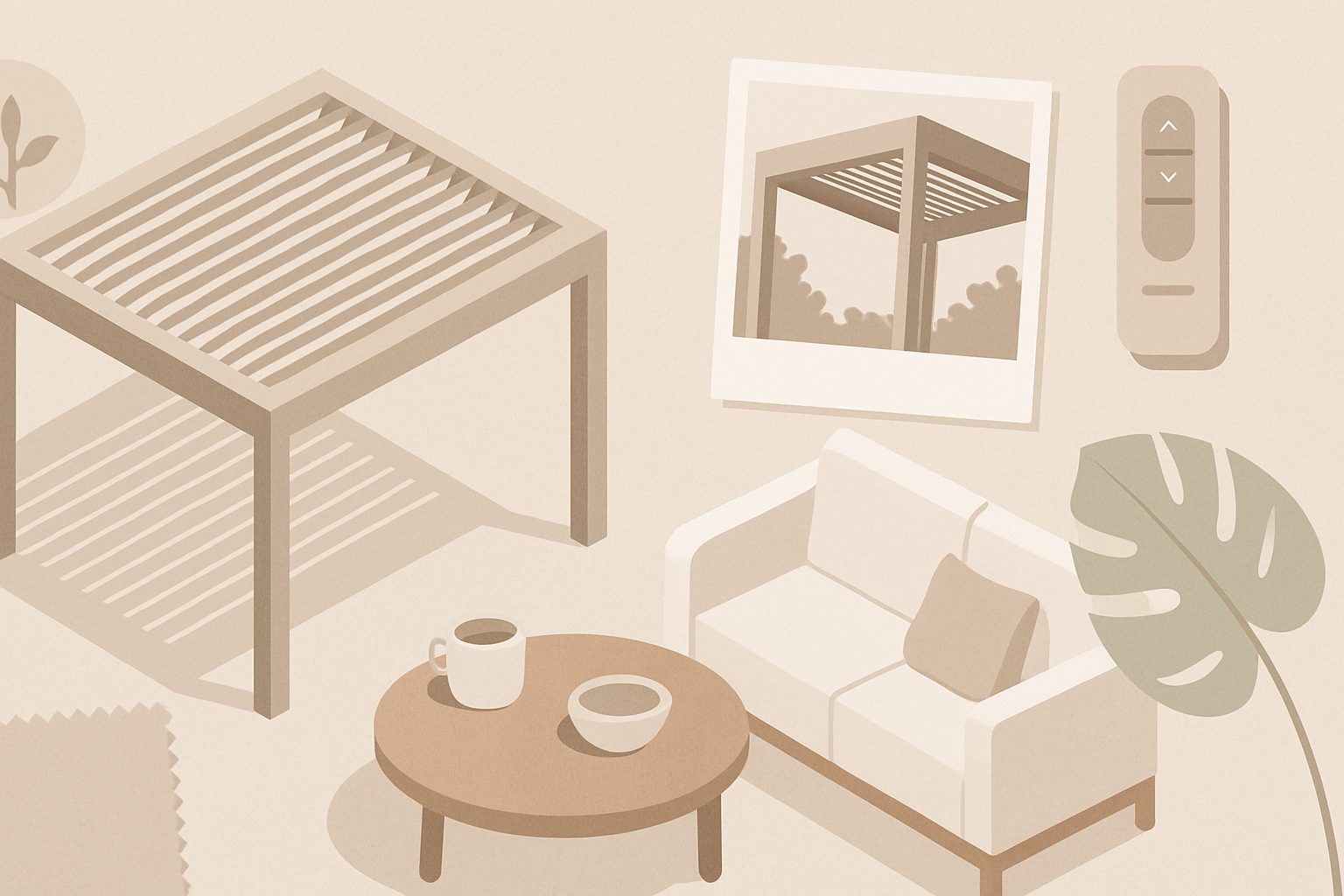
What Is a Motorised Bioclimatic Pergola? A Complete UK Buyer's Guide
A motorised bioclimatic pergola is a garden structure with electronically controlled louvred roof slats that adjust their angle to regulate sunlight, shade, and airflow throughout the day. Unlike traditional fixed pergolas or awnings, bioclimatic models use motors to tilt the aluminium louvres between fully open (roughly 180 degrees) and fully closed positions, creating an outdoor room that adapts to weather and your comfort needs. The term "bioclimatic" refers to the structure's design philosophy: mimicking natural ventilation patterns to maintain comfortable temperatures without relying on air conditioning.
The concept originated in Mediterranean and French architecture, but UK manufacturers and installers have refined them for British weather—particularly unpredictable rain, variable wind, and the persistent challenge of weak autumn sunlight followed by intense summer heat on a south-facing garden.
How the Louvre Angle Adjustment Works
The core mechanism is straightforward: each aluminium louvre (typically 80–120mm wide) is connected to a motor via a rod or cable drive system. When you operate the pergola via remote control, wall-mounted switch, or smartphone app, the motor rotates, adjusting all louvres simultaneously to the same angle.
At 0 degrees (horizontal), the louvres are fully closed, providing complete shade and blocking rain. At 90 degrees (vertical), they stand on edge, allowing maximum light penetration and creating open-air conditions. Intermediate angles—say 45 degrees—offer a compromise: dappled sunlight and partial shading.
The adjustment is usually smooth and takes 30–90 seconds to move from fully open to fully closed, depending on the pergola's size and motor quality. High-end systems offer precise positioning at any angle, while budget models sometimes have preset positions (three or four fixed angles rather than infinite adjustment).
This adjustability is what separates a bioclimatic pergola from a standard louvred shade. You're not stuck with a fixed configuration; you can adapt throughout the day as light and weather change.
The Airflow Science Behind Bioclimatic Design
When the louvres are at an angle, air circulates beneath the structure through the gaps between each slat. This upward-moving airflow—driven partly by temperature differential (warm air under the pergola rises) and partly by natural breeze—creates evaporative cooling, making the space feel cooler than the ambient temperature.
The effect is most noticeable on mild, breezy days (think May or September in the UK). On a still, very hot day, the cooling benefit is less dramatic, but angled louvres still prevent the oppressive heat buildup you'd experience under a solid roof or closed canvas awning.
When the louvres are fully closed, they act as a solid barrier, trapping warm air and creating a thermal shield that can protect plants or equipment from frost in winter—a practical advantage if you're using the pergola to create a sheltered microclimate.
Rain and Wind Sensors: Smart Weather Response
Most motorised bioclimatic pergolas sold in the UK come with optional rain and wind sensors. These are crucial for UK weather.
A rain sensor detects moisture on its surface and triggers the pergola to close automatically, protecting furniture and people from sudden downpours. The sensor is sensitive enough to respond to light drizzle within seconds, though you can usually adjust the sensitivity and the delay before closure. Some systems also log rainfall data so you can review weather patterns through an app.
A wind sensor measures wind speed (typically via anemometer) and closes the pergola if gusts exceed a threshold you set—usually 30–40 km/h. This protects the structure from strain and prevents the louvres from rattling. On a windy coastal evening, this automation is genuinely valuable; otherwise, you'd be closing it manually every time the wind picks up.
Both sensors integrate with the control system (remote, app, or wall switch) so that automatic responses happen without user intervention. However, you can always override and manually operate the pergola if conditions change suddenly.
The Bioclimatic Concept: Creating an Outdoor Room
The overarching goal of bioclimatic design is to create a microclimate—a small area where conditions are noticeably better than the surrounding garden. Rather than fighting the weather with brute-force solutions (like a full roof or retractable awning), bioclimatic pergolas work with natural air and light patterns.
In practice, this means:
- On a warm spring day, open the louvres fully to enjoy dappled shade and air circulation.
- In summer, angle them to reduce glare and heat while maintaining airflow.
- During unexpected rain, close them completely for weather protection.
- In winter, keep them closed to create a sheltered, frost-free zone.
This adaptability is why bioclimatic pergolas suit the UK climate better than fixed structures. You're not forced to choose between shelter and ventilation; you get both, adjusted to the moment.
Key Differences from Other Garden Structures
A traditional pergola offers no weather protection. A fixed louvred pergola or slatted roof provides shade but traps heat and offers no airflow control. A retractable awning gives you either full sun or full shade, nothing in between. A motorised bioclimatic pergola sits at the intersection: motorised like an awning, adjustable like a blind, and ventilated like a pergola.
The trade-off is cost and maintenance. A quality motorised bioclimatic pergola costs £4,000–£15,000+ installed, depending on size and features. You'll need occasional cleaning (removing leaf debris from louvres and sensors) and potentially motor servicing every 5–10 years.
What to Consider Before Buying
First, measure your garden and decide what size suits your space and budget. A 4×3 metre pergola is a popular starting point for a dining area.
Second, think about orientation. South-facing gardens benefit most from bioclimatic design because you can actively manage intense midday sun. North-facing gardens see less dramatic benefits, though rain protection and shelter remain valuable.
Third, research whether the system includes rain and wind sensors by default or as add-ons. This affects both cost and ease of use.
Finally, consider the installation and whether you want integration with existing smart-home systems (some pergolas work with Google Home or Alexa; others use a proprietary app).
For detailed pricing and brand comparisons, see our full cost breakdown and top UK brands guide.
More options
- Motorised & Electric Pergola Structures — Amazon UK (Amazon UK)
- Electric Outdoor Patio Heaters for Pergolas — Amazon UK (Amazon UK)
- Weatherproof LED Strip Lights for Pergolas — Amazon UK (Amazon UK)
- Somfy & Pergola Motor Control Systems — Amazon UK (Amazon UK)
- Garden Pergola Structures & Accessories — AWIN (Primrose / Harrod Horticultural) (Amazon UK)